
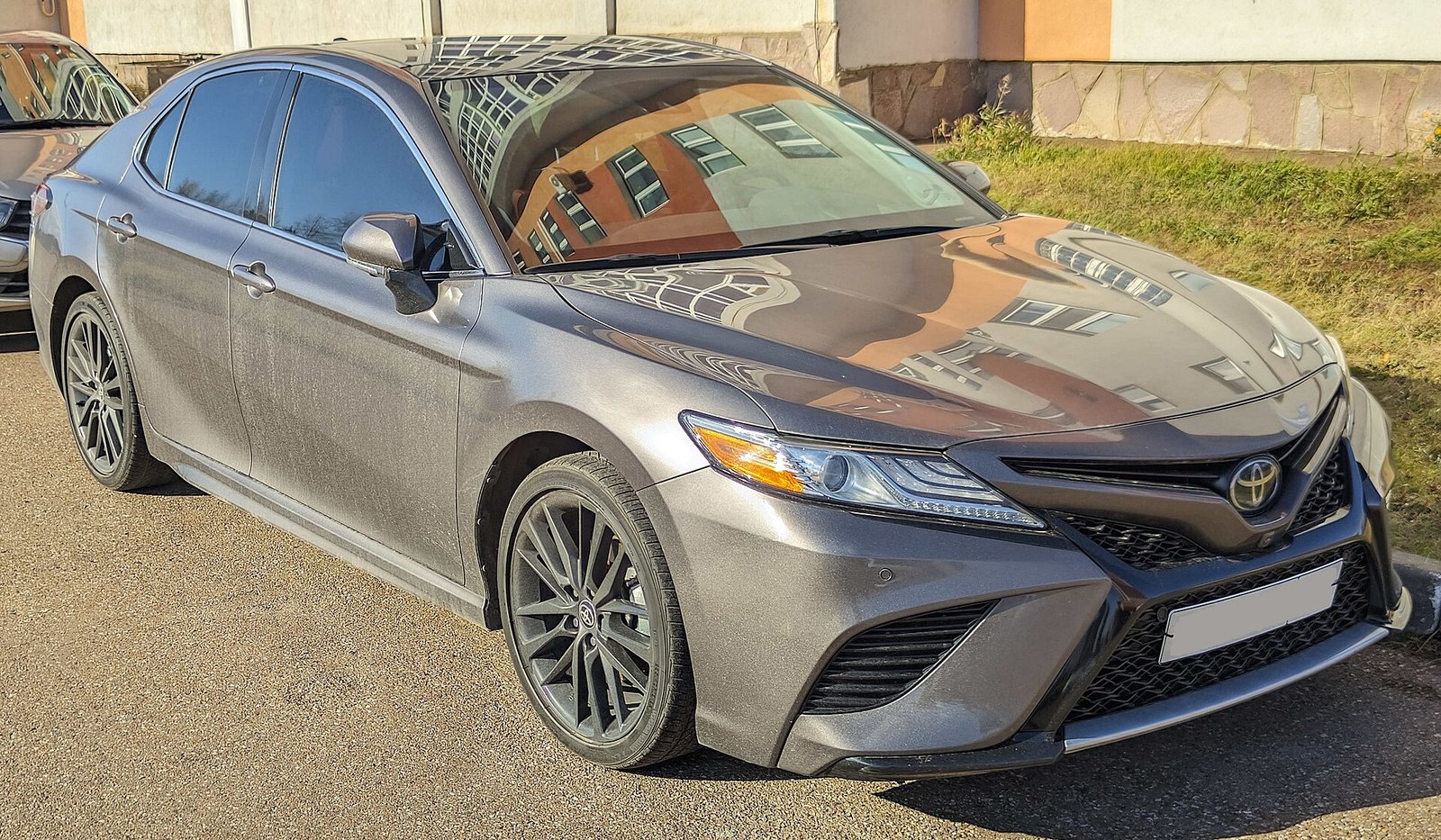

Overview
- Engines
- 2.5L four-cylinder, 3.5L V6, 2.5L four-cylinder hybrid
- On record
- 3 warnings, 13 recalls
The story
Shown at the North American International Auto Show on January 9, 2017, it is built on Toyota's GA-K platform and shares only its Toyota emblems with the car before. North American production began in June 2017 and sales in late July. While the Kentucky plant was refitted for the new platform, some early cars came from Japan. A published reference
A TRD version, V6 only, and all-wheel drive, the first on a Camry since 1991, came for 2020. A facelift for 2021 dropped the L and added an XSE Hybrid. Edmunds, a published reference
Colors
- Ice Cap2023–2024
- Reservoir Blue2023–2024
- Cavalry Blue2023–2024
- Super White2018–2022
- Celestial Silver Metallicyears not known
Show all 16 colors
- Predawn Gray Micayears not known
- Midnight Black Metallicyears not known
- Ruby Flare Pearlyears not known
- Blue Streak Metallicyears not known
- Blue Crush Metallicyears not known
- Wind Chill Pearlyears not known
- Brownstoneyears not known
- Galactic Aqua Micayears not known
- Supersonic Redyears not known
- Blueprintyears not known
- Ice Edgeyears not known
Interiors
- Ashyears not known
- Macadamiayears not known
- Blackyears not known
- Cockpit RedXSE, years not known
Sources: Toyota, Edmunds, a published reference
Specs
Engines
-
2.5L four-cylinder A25A-FKS engine page Toyota, a published reference
206 hp, by Toyota
- Gearbox
- 8-speed automatic Toyota, a published reference
- Drives
- Front-wheel drive, All-wheel drive (2.5L four only, LE and up, 2020–2024) Edmunds, a published reference
-
3.5L V6 2GR-FKS engine page Toyota
301 hp
- Gearbox
- 8-speed automatic Toyota, a published reference
- Drive
- Front-wheel drive A published reference
-
2.5L four-cylinder hybrid Toyota, a published reference
208 hp combined
- Gearbox
- Electronic continuously variable (e-CVT) (Hybrid) Toyota, a published reference
- Drive
- Front-wheel drive A published reference
Motors
- Electric drive motor Toyota
Batteries
- Lithium-ion, 1.0 kWh Toyota, a published reference
- Nickel-metal hydride, 1.6 kWh Toyota, a published reference
Trims
- L (2018–2020) Toyota, Edmunds
- LE Toyota, Edmunds
- SE Toyota, Edmunds
- XLE Toyota
- XSE Toyota
- TRD (years not known) Edmunds, a published reference
- Hybrid LE Toyota, a published reference
- Hybrid SE Toyota, a published reference
- Hybrid XLE Toyota, a published reference
- Hybrid XSE (2021–2024) A published reference
Packages
- Nightshade Edition (years not known) Edmunds, a published reference
Figures
- Platform: GA-K, part of the Toyota New Global Architecture Toyota, a published reference
- First shown: North American International Auto Show, January 9, 2017 A published reference
- Hybrid battery: Under the rear seat, where earlier Hybrids kept it in the trunk A published reference
- US sales: More than 10 million Camrys since 1983, by Toyota in 2017 Toyota
- Safety: Toyota Safety Sense P standard Toyota
Years and what changed
- 2018
New model, in L, LE, SE, XLE and XSE trim and as a Hybrid LE, SE or XLE, with a 206 hp 2.5L four or a 301 hp V6 and an 8-speed automatic. Toyota
- 2019
Apple CarPlay and Amazon Alexa arrive. Edmunds
- 2020
Android Auto becomes standard. All-wheel drive is offered with the 2.5L on the LE and up, and a V6-only TRD and an SE Nightshade Edition join the range. Edmunds
- 2021
Refresh
Facelift with styling tweaks, an optional 9-inch screen and refined safety aids. The L is dropped and an XSE Hybrid added. Edmunds, a published reference
- 2022
The Nightshade Edition comes to the Hybrid, and the TRD gets a color of its own. Edmunds, a published reference
- 2023
Ice Cap replaces Super White, Reservoir Blue comes for the Nightshade and Cavalry Blue for the SE and XSE, and the SE Nightshade gets bronze 19-inch wheels. Edmunds, a published reference
- 2024
No changes. Edmunds
Watch out
Faults owners and the press report, and how to spot each one.
-
Hesitant or harsh shifts in the 8-speed All years
Check: On a test drive from cold, pull away gently and firmly and drive in stop-and-go traffic, feeling for hesitation, lurches or harsh shifts. Shift from R to D and see that it engages without a delay, and look for a check-engine light.
Toyota bulletin T-SB-0122-20 covers 2018 Camrys with the 8-speed that, after a delay engaging from R to D, show a lock-up concern and a check-engine light with codes P07407E or P27567F; the fix is new engine computer software. Bulletin T-SB-0010-18 warns that a mismatch of gearbox and software can cause harsh shifts or flare. In one CarGurus thread, an unofficial source, eight owners of 2018 and later Camrys report hesitation, lag, jerking or harsh shifts, and none says a software update cured it. Toyota, owners' reports (unofficial)
-
Failing low-pressure fuel pump 2018–2020
Check: Ask a Toyota dealer whether fuel pump recalls 20V012000, 20V682000 and, on a 2018, 25V028000 were done.
Three recalls replaced low-pressure fuel pumps in the tank that may fail. NHTSA
-
Brake booster vacuum pump failure 2018–2019
Check: Ask a Toyota dealer whether recalls 18V211000 and 21V890000 were done. A failing pump can take away the brake assist suddenly.
NHTSA
Going to see one? Take the checklist with you.
Open the checklistRecalls
Newest first. Ask the seller for proof the work was done, or check the VIN with NHTSA.
2018 Recall 25V028000
The low-pressure fuel pump in the tank may fail. NHTSA
2023–2024 Recall 24V128000
The second-row center and right head restraint brackets may be poorly welded. NHTSA
2020–2022 Recall 23V865000
A short circuit may develop in the passenger seat occupant sensor, stopping the passenger front airbag from deploying. NHTSA
2023 Recall 23V432000
The wheel lug nuts may be loose, and a wheel could come off. NHTSA
2018–2019 Recall 21V890000
The vane cap inside the brake booster vacuum pump may break, causing a sudden loss of brake assist. NHTSA
Show all 13 recalls
2018–2020 Recall 20V682000
The low-pressure fuel pump in the tank may fail. It is replaced. NHTSA
2020 Recall 20V064000
Porosity in the engine castings may crack and let coolant leak inside or outside the engine. NHTSA
2018–2019 Recall 20V012000
The low-pressure fuel pump in the tank may fail. It is replaced. NHTSA
2019 Recall 19V567000
The passenger seat occupant sensor may be miscalibrated, so the passenger front and knee airbags may not deploy as they should. NHTSA
2019 Recall 19V097000
The fuel filler pipe may not have been reconnected to the tank after a factory inspection. NHTSA
2018 Recall 18V211000
The brake booster vacuum pump rotor may have been machined wrongly, which can cause a sudden loss of brake assist. NHTSA
2018 Recall 18V200000
The pistons may be larger than specified, which could make the engine stall. NHTSA
2018 Recall 18V108000
The fuel delivery pipes in the engine bay may not be properly connected to the fuel hoses. NHTSA
Checked against NHTSA records on November 2, 2026.
Owning
What owners and buyers say
-
Sought after
2022
One source so far
SlashGear lists the 2022 among its best used years, with 81 out of 100 from J.D. Power and full marks from Consumer Reports, though it says long-term reliability is unproven. SlashGear
-
Sought after
The 2023 Hybrid
One source so far
SlashGear calls the 2023 Camry Hybrid one of Toyota's more reliable hybrids. SlashGear
-
Watch for
2018
Less sought after One source so far
SlashGear notes the 2018 had eight recalls and hundreds of complaints, where 2019–2024 had few recalls. SlashGear
Maintenance
Engine oil and filter 2019–2024
Replace every 10,000 miles or 1 year Toyota
Ask the seller: Ask for oil change records, and which oil was used (0W-16 in the 2.5L, 0W-20 in the V6).
Engine oil and filter, hard use 2019–2024
Replace every 5,000 miles or 6 months Toyota
Only for dusty roads, repeated short trips in the cold, long idling or towing
Cabin air filter 2019–2024
Replace every 10,000 miles or 1 year Toyota
Engine air filter 2019–2024
Replace every 30,000 miles or 3 years Toyota
Spark plugs 2019–2024
Replace at 120,000 miles Toyota
Show all 9 services
Spark plugs, V6 2019–2024
Replace every 60,000 miles or 6 years Toyota
Brake booster vacuum pump, V6 2019–2024
Replace at 120,000 miles Toyota
Engine coolant 2019–2024
Replace first at 100,000 miles or 10 years, then every 50,000 miles or 5 years Toyota
Hybrid inverter coolant All years
Replace first at 150,000 miles or 15 years, then every 50,000 miles or 5 years Toyota
Warranty when new
| Basic | 36,000 miles or 3 years Toyota |
|---|---|
| Powertrain | 60,000 miles or 5 years Toyota |
| Corrosion perforation | 5 years ToyotaAny miles |
| Hybrid system | 100,000 miles or 8 years ToyotaThe hybrid battery for 10 years or 150,000 miles, in Toyota's 2022 guide |
Before you pay: every warning, recall and check on one sheet.
Open the checklist